Thursday, April 4, 2019

Abdullah Alburaidi - volcano


Harrat Rahat volcano took place in the western side of Saudi Arabia. This volcanic field is considered to be the biggest lava volcano in the country. It was an explosive volcano because when the explosion took place ash, magma and gases were released into the atmosphere and the surrounding land. The Harrat Rahat is made up of lava that covers an approximate area of 20,000 sq. km.  It is actually twice the size of Lebanon. The last explosion of the Harrat Rahat happened in 1256 AD. This volcanic field is historic as it is the first among many that has recorded accounts. Harrat Rahat also made history because it happened a few kilometers away from the tomb of a holy prophet and coincidentally some minutes after prayers from the people of the holy city. The explosion threatened the nearby holy city because the lava flow continued to stretch for fifty-two days. The volcano lies in Madinah because that was where the explosion took place.

From the look of the area it is evident that past explosions occurred. The quality of water in the area is bad. This must be an effect from the chemical materials that flowed into the water bodies after the explosion. A guest is advised to bring water if they are visiting the area. The by-products of the lava like salt and silt can be seen in some parts of the volcanic site. The area also has a number of scoria, tuff cones and spatter which back up the possibility of past explosions having taken place. The presence of craters is strong evidence that a volcanic explosion took place at the area. With such kind of an explosion the most expected hazards include the destruction of crop and any other vegetation, shortened periods of rains and contaminated water surfaces. People living around the area are likely to suffer skin infections and respiratory complications from the substances released in the atmosphere. It is possible for the Harrat Rahat to erupt again because it is still an active volcano.

https://defence.pk/pdf/threads/the-story-of-the-famous-volcano-in-saudi-arabia-near-the-prophets-saws-mosque.498804/page-2

Week 4- Kilauea Volcano

Visiting Hawaii has long been an aspiration for me. Being able to see Hawaii and all its beauty glory was an absolute trip of a lifetime. Making the trip even more memorable is the fact that I was able to see the remnants of the eruption of Kilauea Volcano.

Kilauea Volcano Eruption


The Kilauea Volcano  an action shield volcano and is one of the most active volcanoes in the world. Kilauea is between 210,000 and 280,000 years old. It has been continuously erupting since 1983. In May of 2018, the eruption that occurred caused a great deal of damage; it destroyed dozens of homes and forced approximately 1700 to leave their community. This eruption began with two focal points--an area in the lower east rift zone where the volcano's surface is splitting and the Haleema'uma'u crater that is to the west of the volcano's summit. 

Lava flowing through the Leilani Estates, via Shutterstock


Although technology is growing leaps and bounds, scientists don't really know why the eruption was so volatile. According to Tracy Gregg, an associate professor of geology at the University of Buffalo, "we don't know enough details about the internal plumbing to be able to give really precise answers to this question, the short answer is that a blob of new magma from deep below the volcano got injected up into the volcanic edifice." What does the future hold for Kilauea? On March 26, 2019 it was announced by the U.S. Geological Survey that the Volcano Alert Level had been lowered to NORMAL. 

My visit involved meeting locals that were trying to pick up the pieces, all maintained their positive outlooks and were really happy to be "home". For many, "home" looks different as there are many repairs and rebuilds to be completed. They say you learn a lot people when they are in times of trouble. I believe this to be the case and I learned that the people of Hawaii love their land and their families. I also learned that they have a great deal of resilience and perseverance. 

Local Woman inspecting lava next to her home

Mount St. Helens


Mount St. Helens

Mount St. Helens was once considered an excellent example of a stratovolcano. This means that it was a volcano that was built up of alternate layers of lava and ash. These kinds of volcanoes are also know as composite cones and are some of the mostly deadly volcano types. Mount St. Helens was formed by the subduction of the oceanic plates. In the case of Mount St. Helens was the Juan De Fuca Plate beneath the North American plate. Mount St. Helens is known for the eruption that started on March 27, 1980. Before this eruption scientists had started to see increased earthquake activity in the area. On May 18, 1980 the volcano finally fully erupted in part to a magnitude 5.1 earthquake. On the north side of Mount St. Helens the volcano collapsed. This volcano was considered explosive. It caused a lot of damage and death. Mount St. Helens has erupted multiple times, but the last known time that it erupted was in 2008.


Hazards that were associated with this particular volcano were lava flows, explosive eruptions and large lahars. These hazards were associated with the eruption and headed down the volcano into the valley below. The ash continued in the 1980 eruption for almost a month. While this volcano was certainly not the biggest eruption, it was widely known for the way that it erupted.

Mount St Helens. (2012). Retrieved from http://www.mountsthelens.com/history-1.html

Week 2: Vinales Valley (Cuba)


Last year I went to Cuba for a J-Term my classmates and I were there for about nine days all together. This picture was taken at Vinales Valley we had to do a lot of driving this day to get to this view, but getting this picture was worth the ride. In doing some research, I found that millions of years ago the bottom of the sea was lifted and a lime stone mountain chain was formed. The story goes on to say that due to erosion big caves were created until their roofs collapsed, which is when valleys were formed.

This picture is just one of the mountains that we seen when we made our trip to Vinales Valley. The rocks on this mountain were very hard and there were even some caves that we got to explore on a boat (which is the second picture)


References: Team, IonizeCMS. “Valley of Viñales.” Valley of Viñales in Cuba |, www.cubafortravel.com/individually/best-visits/valley-of-viales.

I finally got access to the blog (test posting)

I have been having the hardest time getting access to this blog, but it seems like I finally can make a post now. So here is my test post.

Tuesday, April 2, 2019

Week 4 - Volcanoes-Manua Kea

When I was 11, I took a helicopter tour with my parents over Mauna Kea, a volcano on the Big Island of Hawaii. Mauna Kea is a dormant volcano with a peak above sea level making it the highest point in Hawaii. When it's measured from its oceanic base, Mauna Kea the tallest mountain in the world! The most “recent” eruption was about 4,000 years ago, 2460 B.C. It is commonly known to be in its “post-shield” stage meaning as the volcano moves off the hotspot, the lava production slows down leading to a reduced eruption rate. The post-shield alkalic stage reduces the thermal productivity and eventually the “magma chamber” hardens due to a lack of replenishment.
           Mauna Kea is currently measured as a volcano displaying quiescence. The quiescent periods between eruptions are long compared to those of the active volcanos on the island (such as Mauna Loa and Kilauea). The eruptive history began to build from the sea floor around 0.8 million years ago. There are swarms of earthquakes beneath Mauna Kea that might signal an eruption can occur, but, such swarms do not always result in an eruption. There is no foretelling of a future eruption, but the island is prepared for any potential result.
            Some hazards from Mauna Kea include altitude sickness, sunburn, eye damage, and impaired judgment. There are also weather hazards which include server winds over 100 miles per hour and snow storms. I do remember the training before the tour. The team went over the hazards until they were engraved in everyone’s mind. I do remember being scared about going over this volcano, but it was a site to see. It looks like God’s thumb squished a pile of dirt, leaving an imprint behind. I do remember not being very interested in the views, unlike my parents who snapped photos left and right. When I look back, I wish I could experience the tour all over again!
            I do remember the locals warning us not to take the volcano rock home. Apparently, there is a myth that if you take the rock, you will have bad luck. My mom, being the superstitious one was very cautious about me taking home any souvenirs! According to the news clipping my mom kept, it states that Mauna Kea is a great place to ski and snowboard! I didn’t know that a dormant volcano could be a place to do these activities! It also specified that Mauna Kea is the home to the world’s most powerful telescopes and astronomical observations. Being the tallest mountain in the world, I believe this would be a perfect place to stargaze. One day, I will visit Mauna Kea again.
**NOTE** Mauna Kea has a lower altitude than Mount Everest. It would be considered “taller” whereas ME is the world’s “highest” mountain in the world due to its higher elevation above sea level. 

Please excuse my dad’s silly face. These photos were taken on my mom’s camera and glued in her photo album, the news article and clippings are from the tour brochure.


References:
            Mauna Kea Hazards. (n.d.). Retrieved from http://www.ifa.hawaii.edu/mko/hazards.htm

            Volcano World. (n.d.). Retrieved from http://volcano.oregonstate.edu/post-shield-alkalic-stage

            Multiple. (n.d.). Retrieved from https://www.soest.hawaii.edu/GG/HCV/maunakea.html


Monday, April 1, 2019

Week 4 - Volcanoes - Kilauea


I recently visited the Big Island of Hawaii and witnessed the destructive power of the shield volcano known as Kilauea.

Kilauea, as with other Hawaiian volcanoes was not formed at diverging or converging plates, but rather the result of hot spots within the mantle that resulted in the outpouring of basalt onto the Earth's surface.

Kilauea is a shield volcano, characterized by its shallow gradient. Shield volcanoes often form due to the release of highly viscous lava that is able to travel large distances over a shallow gradient. These lava flows typically have high silica and gas content which results in its fluidity. Lava like this, referred to as pahoehoe by Hawaiians, often travel in lava tubes which allow the flowing lava to retain heat, thus allowing it to travel further.

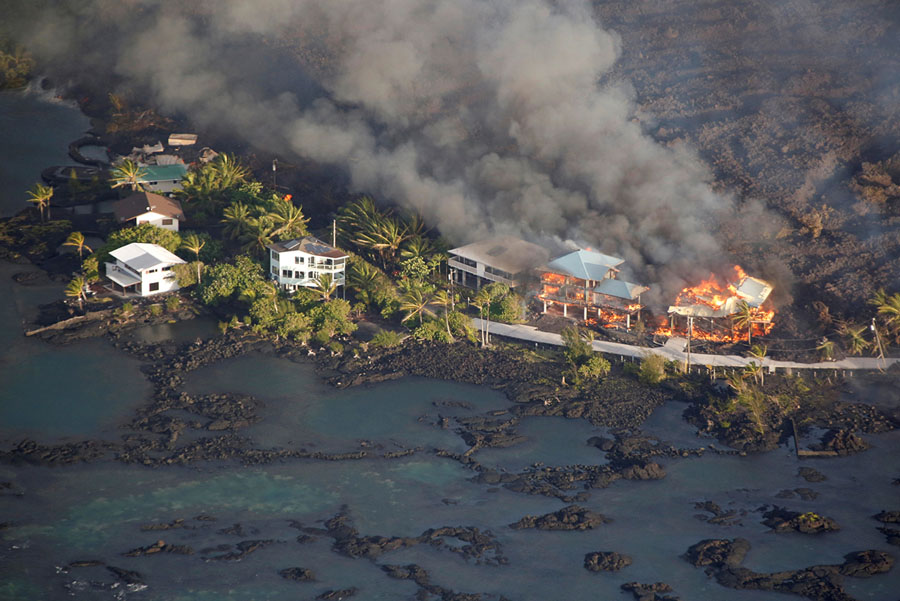
Kilauea erupted continuously from 1983 until September 2018 after an explosive eruption from its vents destroyed hundreds of homes in May 2018.

According to the USGS, Kilauea is still an active volcano but most likely won't erupt again for several more years. Because it is still active, it should still be seen as a threat in the area.

Image result for kilauea
Image retrieved from https://www.theatlantic.com/photo/2018/06/photo-updates-from-kilauea-dozens-more-homes-destroyed/562241/


Sources: