Sunday, April 7, 2019

Yellowstone Caldera

The Yellowstone Caldera is located in... Yep you guessed it Yellowstone National park. This park is mostly located in the northwest part of Wyoming and also has parts in Montana, and Idaho. The super volcano has only erupted 3 times in the past 2.1 million years. The Volcano has been created and changed with each of the eruptions and originally formed over a hot spot under the earths crust. The last eruption of the volcano put almost 240 cubic miles of volcanic ash and rock into the sky! As well as the incredible eruptions the area around Yellowstone experiences almost 1000 earthquakes a year, but many of the earthquakes are small and very harmless to the population. Although, it would be rare the volcano still has a change to erupt again in a few centuries. And if it did erupt again it would throw out ash and dust thousands of miles across the US destroying crops, shutting down power plants, and even destroying buildings. The chances of this eruption are slim, almost the same as the earth getting hit by a asteroid. Phew! 
References:
Program, Volcano Hazards. Yellowstone Volcano Observatory, volcanoes.usgs.gov/observatories/yvo/.
“Yellowstone Caldera.” Wikipedia, Wikimedia Foundation, 16 Feb. 2019, en.wikipedia.org/wiki/Yellowstone_Caldera#Yellowstone_hotspot_origin.

Week 4 - Mount Redoubt - Mike Kaszuba

For my travel hot spot, I visited Mount Redoubt, which is a Volcano near the cook inlet in Alaska. I can see this Volcano every day. Its has last been reported active as late as 2009. Finding this, I did more research into the activity of January through March of 2009. Seismic activity has been reported, along with vapors released into the air. The earthquake the shook the area is only assumed to be in relation to the volcano, but the timing is almost too perfect to not see the relation. Others say the earthquake could of disturbed the dormant Mount Redoubt. In the museum in downtown Anchorage, views from the Cook Inlet part of Anchorage show that the vapors released could be seen from the town, which is located a crossed the water. This Volcano just adds to the dangers that consists of making Alaska your home.

https://en.wikipedia.org/wiki/Mount_Redoubt#2009

Week 4- Mauna Loa Volcano

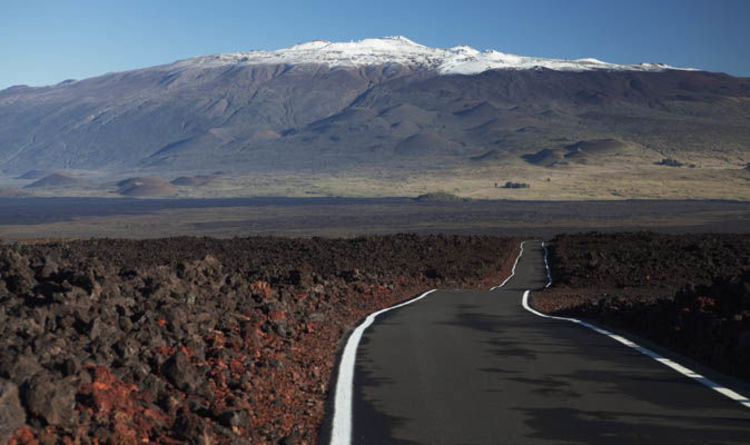
For my travel hot spot this week, I chose a famous Hawaiian Volcano called Mauna Loa! The first fun fact that I encountered while visiting was that it is actually the largest active volcano in the world! It covers half of the island of Hawaii and about 85% of all the other Hawaiian islands combined. Mauna Loa has erupted 33 times since 1843. Due to the high amount of eruptions scientists are constantly monitoring the volcano to watch for signs of another eruption in the future. Volcanos have always been very interesting to me. The history around them and the different stages of development each one has is very mysterious. Dense clouds of hot ash that spew out of a volcanic eruptions as well as lava is mesmerizing to me. Most volcanoes will swell up or inflate when an eruption is about to occur which is one way scientists are able to monitor the eruptions.


References: https://volcanoes.usgs.gov/volcanoes/mauna_loa/


Image result for mauna loa

Week 4 - Erta Ale - Kody Johnson


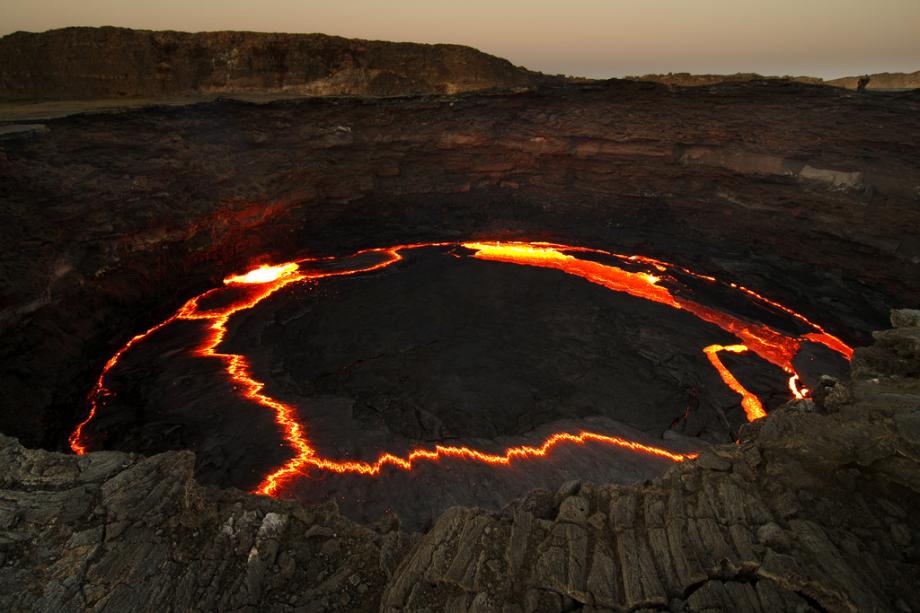
I chose Erta Ale for my volcanic visit this week. The name is what caught my attention, but Erta Ale is so much more. The name Erta Ale translates to smoking mountain. Erta Ale is a beautiful volcano that is continuously active. It sits in Northeast Ethiopia. Erta Ale stands at 2,011 ft tall and has a massive opening. Erta Ale is made up of very dark. The rock appears to be the igneous rock, basalt. The volcano is nice to look at with its steady flowing stream. It isn’t very eruptive, but the lava continuously flows. This led me to the conclusion that Erta Ale is effusive. You can see that there are pahoehoe lava fields present. It’s interesting to see the new fields meet the older lava flows. Erta Ale is a sight to see. When I think of Ethiopia, I don’t exactly think of an active volcano. I guess volcanoes can be anywhere considering many mountains are formed by volcanoes. Erta Ale doesn’t pose much of a threat. It doesn’t appear to have civilization located directly near it. Erta Ale was definitely a site to see since it is one of the most active volcanoes on earth.

Mayon Volcano - Cobe Karhoff

Mt.Mayon tam3rd.jpg

Mount Mayon, also known as the Mayon Volcano is an active stratovolcano on the island of Luzon in the Philippines. It’s located about 15 kilometers northwest of Legazpi City. Its current elevation is 2,463 meters. This volcano is located on a convergent boundary between the Eurasian and Philippine Plate. The lighter continental plate floats over the top of the oceanic plate, forcing it down, and allowing magma to well up from the Earth’s interior. This makes Mayon a very active volcano; in fact, it’s the most active volcano in the Philippines, having erupted 47 times in the last 400 years. The first recorded eruption was in 1616, and the last major eruption was on October 1st, 2006. Because of the location of the volcano and its convergent boundary, Mayon will continue to be a very active volcano. The most devastating eruption happened on February 1, 1814, when ash and tephra rained down around the volcano, burying a nearby town to a depth of 9 meters. 2,200 people died. The rocks are mafic and ultramafic so therefore the eruptions from Mayon are more quiescent. Due to the consistent eruptions, I am not sure why people build towns and cities near this dangerous volcano. 

Week 4- Mount Vesuvius, Meagan Valero

Image result for mount vesuviusMount Vesuvius, located on the Gulf of Naples in Campania Italy is best known for its eruption in AD 79 that led to to the destruction of the Roman cities of Pampeii, Herculaneum, Oplontis, and Stabiae, as well as other settlements. The eruption ejected debris and gases 21 miles in to the air and spewing molten rock and pumice. The eruption ultimately released a hundred thousand times the thermal energy released by the Hiroshima-Nagasaki bombing.
Vesuvius has erupted a number of times since, and is regarded as one of the most dangerous volcanoes in the world due to the densely populated region. Vesuvius was formed as a result of the collision of two tectonic plates, the African and the Eurasian. The former was subducted beneath the latter, deeper into the earth. As the water-saturated sediment of the African plate was pushed to hotter depths, the water boiled off and lowered the melting point of the upper mantel enough to partially melt the rocks. Magma is less dense than the solid rock around it, it was pushed upward breaking its way through a weak spot at the Earths surface, thus forming a volcano. Vesuvius is a distinctive humpback peak, consisting of a large cone partially encircled by a steep rim of a summit caldera caused by the collapse of an earlier and and originally much higher structure called Mount Somma. The height of the main cone has been constantly changed by eruptions but was measured at 4,203 ft in 2010. Vesuvius is regarded as an active volcano, however its current activity produces little more than sulfur-rich steam from vents at the bottom and walls of the crater.   
Image result for mount vesuvius
 

Eric Valero - Week 4

Volcanism is an ever present feature of our planet's (and many others') geological activity. Volcanoes provide evidence for the movement of tectonic plates, and allow us to study the mineral composition of magma far below the Earth's surface. For this weeks virtual tour, we will be taking a marine submersible 4600 feet below the Earth's surface to study the Axial Seamount.

We are studying the Axial Seamount for several reasons. For one, most volcanoes on earth are actually underwater, a fact which is obvious given that oceans cover the majority of the Earth's surface, but which is often lost on people when considering volcanic activity. Underwater volcanoes have created most of the chemical composition of the Ocean floor, and we can witness this in the 40 ft thick lava flows around the Axial Seamount.

Volcanoes usually lie along regions where tectonic plates are colliding, called subduction zones. The Axial Seamount, however, has a somewhat mysterious position that isn't entirely understood by scientists. It is believed to have formed over the Cobb hot spot, which is long dormant. Much expansion has occurred in the region, leading to the Axial Seamount and a chain of volcanoes it resides alongside to move over the last several hundred thousand years. It is believed that the Seamount is older than the oceanic ridge it currently bisects, which is not a common phenomenon.

Due to its interesting geological history, the Axial Seamount is one of the most widely studied sub oceanic geological features today.