Sunday, September 8, 2019

Global Warming Kevin D

For this travel journal, I decided to travel to the coastal city of Orlando, Florida. Initially, this was puzzling to me, as Orlando is not coastal in 2019. However, the rising global temperatures over the last 5000 years have caused sea levels to rise greatly in a process called Thermosteric rise. Some of this rise can be contributed to natural causes, such as glaciers melting and sifting the oceans water. This is, however, largely a result of warming caused by humans. Humans cause this rise in temps by increasing the concentration of gases that trap heat in the atmosphere. Burning large amounts of fossil fuels and eliminating tropical forests, like the Amazon, both contribute to the rise in temp, and the resulting higher sea levels. This can really only be caused by rising temperatures in the earth's atmosphere, so we know warming did occur. As to whether or not an effort was made to stop this warming, I would guess not. If so, it was too little too late. Overall, it really made me wish we had done more to stop said warming.

Kevin

Image result for florida coast
https://www.npr.org/2019/02/14/694479180/after-16-months-of-dead-fish-manatees-and-dolphins-floridas-red-tide-ebbs

Week 8 - Global Warming


Like previous great time travelers such as Marty McFly, I’ve managed to step into the future year of 7010 and visit the coastal town of Charleston, South Carolina. Charleston was a popular tourist attraction for family, so I figured it would’ve been great to see it in the future, but I was amiss to find it underwater. The more structurally intact areas of the East Coast built consistently higher dams and walls to avoid being taken over by the increasing sea levels. By the mid-2050s however, Charleston and the rest of the East Coast would not be able to battle the increasing water levels after the polar ice caps completely melted due to the lack of carbon control measures. 

Finding alternative sources for carbon seemed to be muddled too deeply in politics and lobbying efforts in most governments, therefore many societies worked towards building safe zones and damming efforts. A few nations even turned to the space race which enabled a newer lower orbit society to live above the ground, but the population appeared to be minimal due to the infrastructure costs.

In the end, humanity had avoided nuclear catastrophe by attempting to solve desertification and finding alternative supplies for potable water.  Additionally, humanity developed better ways to survive in a warmer climate and a carbon-rich environment. So in 7010, of the 5 million cubic miles of ice on Earth, there was barely any signs of it left. Most cities now had climate-controlled habitats where the outside weather now hovers at roughly 80 degrees Fahrenheit. 

Week 7 - Death Valley


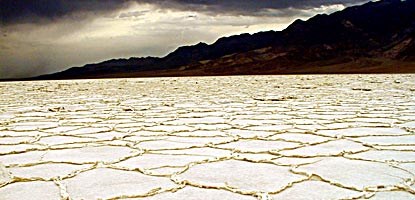
The area I chose to visit was the salt flats in Badwater Basin, which is an area that “covers nearly 200 square miles and is one of the largest protected salt flats in the World” (NPS, 2015). According to my guide during the tour, there are three basic components needed for the formation of salt flats which are source of salts, an enclosed basin, and arid climate. The composition of much of the salt flats include sodium chloride, or table salt, with silt, fine sand, and clay. Other minerals include calcite, gypsum, and borax. The colors range from white to light grays to brownish grays.

The basin boundaries must be mapped along with any additional deposits which help protect or stabilize the surrounding areas. The informational packet at the basin also suggested that much of the area was restricted, so I’d certainly be curious to find out how often surveys are conducted and what methods researchers use to work in such a restrictive area.


References

Fridrich, C.J., Thompson, R.A., Slate, J.L., Berry, M.E., and Machette, M.N., 2012, Geologic map of the southern Funeral Mountains including nearby groundwater discharge sites in Death Valley National Park, California and Nevada: U.S. Geological Survey Scientific Investigations Map 3151, 20 p. pamphlet, 1 sheet, scale 1:50,000.

National Park Service (2015, February 28). Salt Flats. Retrieved from https://www.nps.gov/deva/learn/nature/salt-flats.htm

Saturday, September 7, 2019

Week 8 - Global Warming

New York City

New York City, year 7019, 5000 years in the future. Visiting this beautiful city is an eye opening experience and looks so very different than the year 2019. Scientists long talked about global warming and the effect it would have on coastal cities like New York City. They predicted, if things didn’t change, New York City would suffer consequences such as being completely buried under water. Years of global warming anthropogenic effects; continuous greenhouse gases, carbon emissions, landfill release of methane, etc. along with natural effects, such as wildfires, natural disasters, and volcanic activity, would cause waters to rise , animal/wildlife become extinct and farmlands are compromised. 

New York City underwater. Credit: dailymail.co.uk
These natural and anthropogenic global warming effects forced the people and city to modify and adapt to a possibility of living in a city of water. New York City took measures to ensure the future of the city. The 7019 New York City is one that adapted to the consequences of global warming and created an amazing city and environment where water became a natural part of the city. Flood walls, water resistant building materials, solar power, and deployable flood barriers are just some of the ways the city adapted to the future.


Futuristic New York City. Credit: businessinsider.com


Week 8 - New York - Vicente Cabrera

Photo retrieved from the nymag(http://nymag.com/intelligencer/2016/09/new-york-future-flooding-climate-change.html)

The year is 7019, and New York has never looked any worse than it ever has. The skyscrapers that once stood tall and proud have long been toppled due to the moving sea currents. Central Park is now 10 meters underwater, with no easy access to the bottom. Aquatic animals now live in the ruins of buildings of the area.
The cause of all of this was caused mostly by human error in dealing with greenhouse gasses. The excess use of fossil fuels in cars, airplanes and boats caused an increase in carbon dioxide being released into the atmosphere. The ever increasing carbon dioxide caused a severe temperature spike in the entirety of the world. The Arctic ice pack and the Antarctic began melting, causing a rise in sea level by several meters, and resulting in New York being submerged in water.
Global warming occurred with prolonged, necessary use of fossil fuels. The fossil fuels contributed by just being a semi-cheap method of creating many many things. Society tried to ban the use fossil fuels, including government raids to take away fossil fuels, however it was too little too late. Banning fossil fuels created a black market for them, resulting in more dangerous mining and sped up the process of heating up the planet.


(Cool things I found along the web)
Information on Arctic Sea Ice Extent. https://nsidc.org/arcticseaicenews/
How Climate Change will effect New York. http://nymag.com/intelligencer/2016/09/new-york-future-flooding-climate-change.html

Week 8 - Global Warming

Orange County, California
By: Kevin Kapka


The year is 7100 and I am living in Orange County California. The weather here is extreme, so extreme there is nothing like it. There are basically 2 seasons of the year. In no particular order there is a heavy rain and really wet season. The rain participation has increased by more than 50% from the year 2019. Due to the fact that carbon dioxide is so high the plants and vegetation has made an extreme halt in progress and the whole area is a desert. With that being said, The temperature is  extremely hot here and when it is not raining the heat takes over. With all the levels of carbon dioxide so high the heat is deadly and that forces many livestock not to grow. Overall, the the future of California in general is a bad one and it will continue to do worse but at this point there is not much our people can do to save this world. It is officially too far gone now I fear the cycle will have to repeat itself to get their environment balance back.

Tuesday, September 3, 2019

Rausch-Week 8:Global Warming

It is the year 7010, and I, a time-traveler from the distant past, have been sent on a scientific expedition to document the effects of global warming on coastal cities located in the United States.  I have decided to explore what was once known as the coastal city of Miami in Florida.  Many organizations have warned of the effects of global warming affecting the rise of sea levels, and Miami was among the cities that were identified as being most at risk.  Miami has been identified as being at risk of becoming a future Atlantis for many reasons, one of them being that the limestone that makes up much of the coastline in Miami-Dade county and Palm Beach is incredibly porous.  The rise of sea levels makes the submergence of Miami an unavoidable and tragic certainty.  Indeed, when I arrive by boat to where Miami once stood as a coastal metropolis, I can see submerged buildings underneath the ocean water.
Artist Rendition of Miami in 2100 A.D.
Retrieved from https://www.youtube.com/watch?v=PFFRK0qv_4I

How did the sea levels rise so substantially to be able to swallow a once great city?  The process has started rapidly ever since the Industrial Revolution, when humans began burning fossil-fuels and decimating many of Earth's forests, which in turn released copious amounts of carbon dioxide into the Earth's atmosphere.  This deposit of carbon dioxide is responsible for raising the Earth's surface by 1°F over the past 2 centuries.  However, much of this carbon dioxide isn't retained in the Earth's atmosphere, instead it is trapped in Earth's many oceans.  The temperature increase over the past century has only raised the average temperature of the Earth's oceans by 1°F but it is rapidly speeding up.  It is also important to note that when the oceans are subjugated to increased temperatures, they expand(which explains the rise of sea levels).  As I continue to observe my surroundings in the ocean, I notice that most of the coral in the area is phosphorous instead of the vibrant orange and reddish hues that I come to expect.  This is yet another effect of global warming.  The rising temperatures of the ocean has caused the coral in the area to expel the algae that lives within its tissues, which in turn causes it to "bleach" or become white.  While this bleaching process doesn't guarantee death, much of the coral population has succumbed to disease due to being more highly susceptible as a result of a lack of nourishment.  
Bleached Coral
Retrieved from https://phys.org/news/2016-04-large-barrier-reef-dead-years.html

While the natural geology of Miami(such as the Miami Limestone) has played a part in Miami's submergence, it is tragic to think that this could have been avoided if we as a society could have avoided our over-reliance on fossil fuels.  Thankfully , society has undergone huge changes in energy consumption in an effort to avoid further catastrophe.   Those who have retreated further inland can be seen being more conscious in regards to relying more heavily on renewable energies; such as wind and solar.  Other efforts taken to reduce our carbon footprint include forest reclamation and being more efficient in regards to water waste(shorter showers, installation of WaterSense fixtures).  Viewing a resurgence of vast forests fills me with the hope that humanity is capable of great change, even if it comes as a reactionary measure due to horrible consequences.

References

Borunda, A. (2019). Ocean warming, explained. Retrieved from https://www.nationalgeographic.com/environment/oceans/critical-issues-sea-temperature-rise/?beta=true#close

Denchak, M. (2017). How to Stop Global Warming. Retrieved from https://www.nrdc.org/stories/how-you-can-stop-global-warming

O'Brien, M. (2018). Will climate change turn Miami into a 'future Atlantis'?. Retrieved from https://www.pbs.org/newshour/show/will-climate-change-turn-miami-into-a-future-atlantis

Stager, C. (2012). What Happens AFTER Global Warming?. Retrieved from https://www.nature.com/scitable/knowledge/library/what-happens-after-global-warming-25887608/