Saturday, April 4, 2020

Volcanoes - Kilauea - TraceyP

For this week's trip around the wonderful world of geology, I visited one of the most active volcanoes on the planet!

Kilauea is located on the Big Island of the Hawaiian Island chain, so named because it is the largest island (super original). The island also shares a name with the State of Hawai'i, but is referred to as "The Big Island" or "Hawai'i Island" to distinguish it from the name of the state.
Satellite photo of Kilauea caldera

Kilauea is a shield volcano, a type of volcano comprised almost entirely of liquid lava flows. Due to this, shield volcanoes are typically low and wide, resembling a shield lying on the ground. True to form, Kilauea's eruptions have been near constant with fluid magma bubbling out of the mouth of the volcano for the last 30+ years.
Kilauea lava flow (Science News)

Not located at the junction of any tectonic plates, Kilauea is a hotspot volcano. This type of volcano is formed by magma pushing directly through the crust. As the tectonic plates move over the hotspot, new mountains (undersea or visible) are formed. The Hawaiian hotspot is responsible for the formation of the Hawaiian islands, as well as many other under-sea mountains. Kilauea is the youngest of the Hawaiian hotspot volcanoes and one of the few still active.

Graphic representation of hotspot volcano formation


Kilauea represents little danger to the residents of Hawai'i beyond the danger posed by liquid lava flows. There is nearly no explosive eruption risk, only the nearly unstoppable nature of the large lava flows that have been witnessed throughout history. This type of flow presents its own dangers, as the residents of Leilani found out in 2018.

Friday, April 3, 2020

Week 4 - David Clark - Volcanoes (Mt St. Helens)


60 miles from my home is Mt St. Helens, which was the most destructive eruption in US history. I am learning that Washington state is home to many geologically interesting specimens, with this being one of them. The photo above is a before and after of the mountain, the difference is startling.

Another week of quarantine so I decided to hop into the car and take another trip. This time, neither my daughter or dog would attend, but my cat, Arya. We loaded up and headed southeast to Mt St. Helens. The drive didn't take long, which made it a little unnerving to know how close I live to an active volcano. We paddled out onto the lake pictured about and sat in the boat, enjoying nature. She meowed twice, which meant she was asking why the volcano is even there in the first place. I told her it is a part of the cascade mountain range, which itself is part of the Pacific ring of fire. She meowed once in acknowledgement. The cascade range is being fueled by the subduction of the Juan de Fuca oceanic plate beneath the North American plate. And yes Arya, the volcano is still active! She let out a series of meows, obviously disturbed that I have taken her so close to an active volcano. I told her that in 1980, the volcano looked very different, it was a beautiful conical shaped volcano. However, on May 18th, it exploded in a massive lateral eruption equivalent to 1500 Hiroshima atomic bombs. The cause for the explosion was pent up gas that was created by lava in the volcano inching towards the surface.

She looked at me, nodded her head, and meowed solemnly. I told her that people died, the area hit by the blast was decimated, and that a "lahar" was created from all the melted ice water and volcanic ash and debris. This lahar flooded rivers and poured through valleys. Taking rocks, cars, trees, and anything else unlucky enough to be in it's way. The ash from the explosion rose high into the sky and rained down upon the land in a six-hundred-mile radius, turning day into night. She let out a long, loud meow. She wanted to know if it could happen again. Indeed Arya, this is an active volcano, so it could happen again. In fact, even more disturbing is Mt St. Helens brother, Mt Rainer. He is also an active volcano, due for an eruption. Basing what we know from St. Helens, the devastation could be very similar. However, the mountain will let us know of an impending eruption in the form of earthquakes, gas release, and increase of temperatures. Lucky for us, the mountain has shown no sign of these symptoms. Arya and I headed home, still uneasy about our close proximity to the volcanoes, but glad we understand their underlying behaviors.


Thursday, April 2, 2020

Week 4 Cotopaxi Volcano - Michael Nyadimo

This week i have decided to take a trip to Ecuador to look at the volcano called Cotopaxi. It is said that Cotopaxi is the most active volcano in the world. There have been 87 eruptions in history that were recorded with the most recent happening in 2016. The volcano features a snowy substance around its cone which are just its glaciers. Cotopaxi is also classified as a subduction volcano meaning that it can erupt violently. Usually subduction zones are created when the oceanic crust and continental crust collide. With that being said, it is uncertain when the volcano will erupt next.


All you need to know about Cotopaxi National Park - Wanderbus Ecuador

Week 4 - Krakatoa - Jacob Norenko

On this lovely week I decided that I wanted to visit the famous, and explosive, Krakatoa! It is probably most famous for creating the loudest sound in history. It is located in Indonesia along the ring of fire. The tectonic plates that formed this magnificent volcano were the Eurasian plate and the Indonesian-Australian plate. The Indonesian-Australian plate went underneath the Eurasian plate when creating this volcano. Krakatoa is a stratovolcano due to it's conic shape and size, which erupts often and is explosive. It has even erupted several times in the last 10 years and is likely to continue to erupt. When it does erupt the resulting lava and ash is very destructive. The ash can even create volcanic lightning. Truly a sight to behold. It's famous eruption in 1883 even caused tsunamis. One can only hope that it does not reach the destructive potential it once had back then.


Incredible footage shows a rare display of lightening spewing out of the Indonesian volcano Krakatoa. The volcano, which annihilated 36,000 people in an eruption in 1883, hurled glowing rocks into the sky
Weston, P. (2018, October 31). Deadly Krakatoa stirs again: Erupting volcano puts on awesome display of volcanic LIGHTNING in incredible footage. Retrieved April 2, 2020, from https://www.dailymail.co.uk/sciencetech/article-6337713/Rare-display-lightning-Indonesian-volcano-Krakatoa-captured-STUNNING-footage.html 

Wednesday, April 1, 2020

Week 4 Yellowstone Volcano - Mike Bruno

This week I decided to head to Yellowstone to check out the Yellowstone Volcano. The Yellowstone Volcano is likely located over a hot spot in the North American continental crust. This type of volcano formation is known as Intraplate Volcanism. The area around the volcano is raised and this is due to the build-up of magma underneath the earth. While visiting the location I was informed that Yellowstone is believed to have erupted a few times over the last couple million of years. Right now Yellowstone is believed to be quiescent but, it is believed that it could erupt again one day. If this takes place there will be a large blast radius that would likely cause a large death toll. I find that thinking about the possible eruption too long is unsettling. Still, this week's trip to Yellowstone was very interesting!

Week 4- Sydney Rodriguez

This week I decided to visit Mount Vesuvius! It was created 4.6 million years ago when the African plate sunk underneath the Eurasian plate, and later it reached the surface, attaching itself to the surface of Italy due to deposits from various eruptions. The slopes are covered with vineyards and orchards while if you go higher up the mountain, you will see oak and chestnut trees. On the northern side of the mountain along some slopes of Mount Somma, there are woods that go all the way to the summit. If you go to the western side, you'll see chestnut groves and various shrubs and small trees related to the pea family (broom). Higher up the slopes, you can see the slopes of the cone where the surface is pretty much barren. When the mountain is dormant, sometimes you can see tufts of meadow plants. Vesuvius has been both explosive and quiescent. The last eruption was in 1944. It erupted when a slab window built-up pressure due to the heat from the Earth's mantle layer melting rock of the African plate. There are various hazards associated with Mount Vesuvius. First, it has a pyroclastic flow, which is a current of fast-moving hot gas and volcanic matter (tephra).
Second, it has ash fall and lava flows. Mount Vesuvius has taken many lives throughout its history. Mount Vesuvius was running on a 20-year erupting schedule, but it has not erupted in 70 plus years, but it is an active volcano and will probably erupt again.
Volcanoes of Italy: Mount Vesuvius - Italian Dual Citizenship

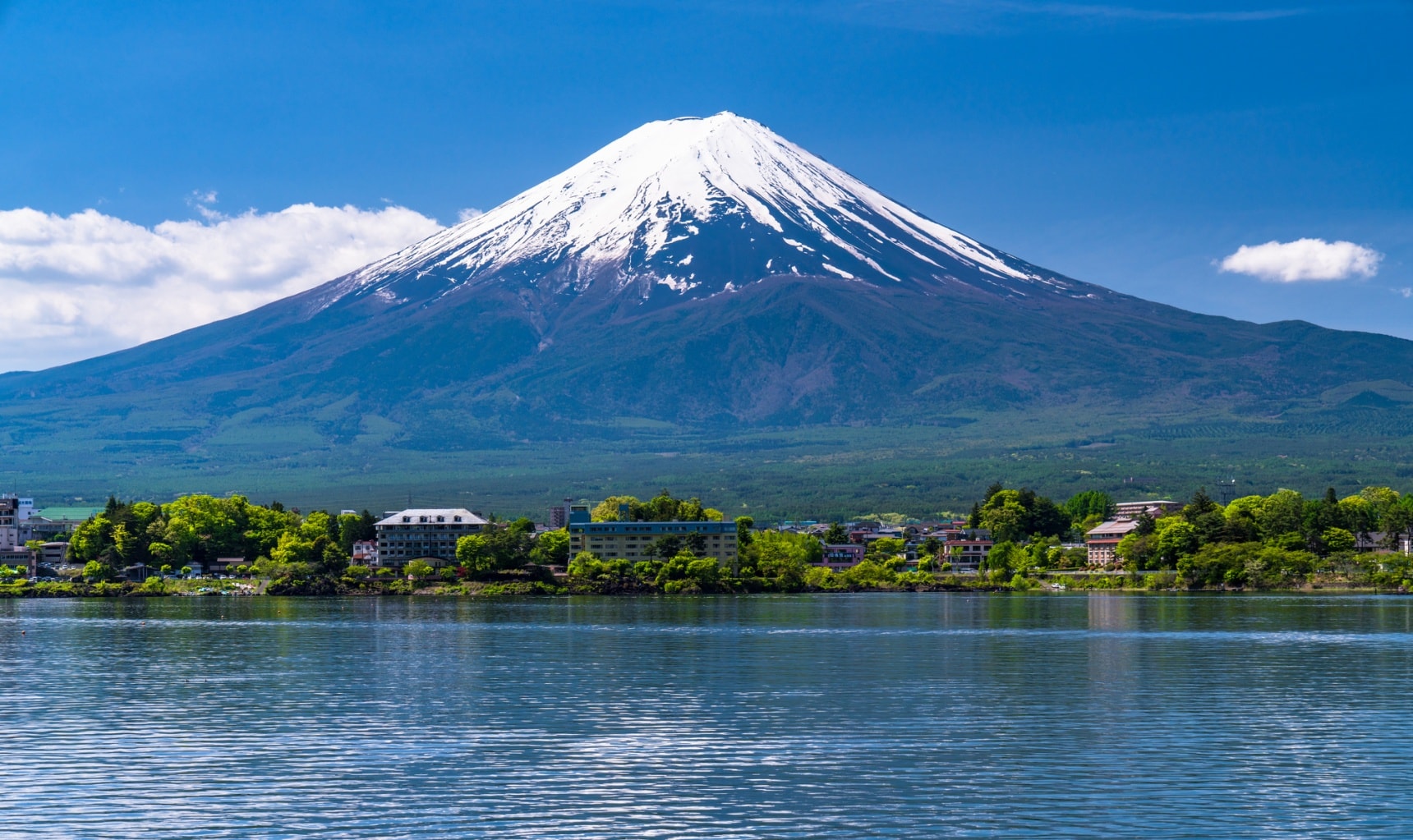
Week 4 - Mt. Fuji Volcano - Jeremy Haynes

This week, my Wife and I decided to visit one of the main island's of Japan that is home to the beautiful active stratovolcano, Mount Fuji. My Wife was curious of the term 'active' and how it is used to describe Mt. Fuji in which I explained that if a volcano has erupted at least once within the last 10,000 years, it's considered active. Within this island named, 'Honshu', Mt. Fuji exists from the base of Mt. Komitake. When telling my Wife of this, she didn't seem to understand in which I told her how a stratovolcano, or composite volcano, is formed through layers of hardened lava, ash, and pumice. I continued in telling her how Mt. Fuji is located at a triple junction where the Philippin Sea Plate, Eurasian Plate, and North American Plate all meet. Considering the Pacific Plate's location beneath the other plates mentioned, it is constantly being subducted in which generates volcanic activity. As we ventured around the mountain, we noticed the formation of the crater named, Mt. Hoei. 'Hoei's creation points to the evidence of this mountain's last eruption that took place in the early 18th century. At this point, we encountered a tour Guide that provided information about the last time 'Fuji had erupted. The Guide explained that when 'Fuji explosively erupted in the early 18th century, it produced almost no lava flow but released millions of cubic metres of ash that reached miles upon miles away. The Guide also explained that even though this eruption took place hundreds of years ago, if 'Fuji erupted again, millions of lives within surrounding cities, structures, railways, and roads could potentially be negatively impacted by the hazards associated with volcanic ash or lava. Continuing, the Guide mentioned how the last eruption stemmed from a sizable earthquake that took place over a month prior to the eruption. Considering the Tohoku earthquake in 2011 resulted in no eruption from 'Fuji, such eruption could still be possible. The tour Guide also mentioned an interesting fact that 'Fuji's stratovolcanic presence consists of four separate volcanic layers including (top-down) Mt. Fuji, Ko-Fuji (literal meaning: Old-Fuji), Komitake, and Pre-Komitake. This fact points to the notion of what is Mount Fuji today, began with some form of collision among the triple junction plates below, added layers of stratovolcanoes above, and the help of millions of years of course!

All About Climbing Mount Fuji

[Image Above] Source: (Hamlin, 2019)

References:

Hamlin, E. (18 Jun. 2019). All About Climbing Mount Fuji. Retrieved 31 Mar. 2020 from: https://allabout-japan.com/en/article/6996/.