Sunday, November 4, 2018

Week 2 - Death Valley

Image result for death valley national park

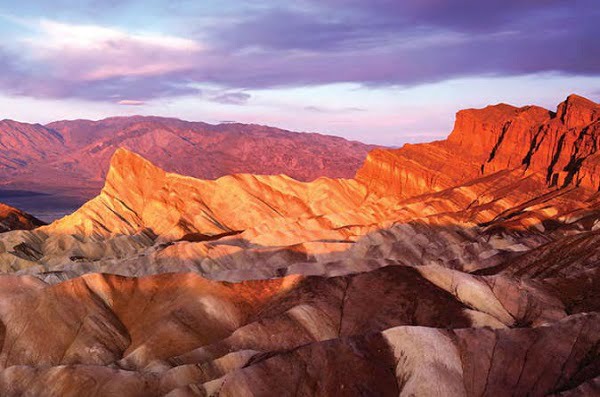
Our family decided to visit Death Valley, established as a National Park in 1933. It's a harsh desert climate spanning about 3 million acres. The formations here have taken place over millions of years, broken down into different eras. One of the major contributors to geological changes in Death Valley is volcanic activity. The majority of the rock formations having light colors and coarse texture suggest they are granite and indicate a plutonic (or intrusive) formation. These rocks were exposed due to uplifting and erosion.

Yosemite National Park's El Capitan


On and off for years my desktop background was of Tunnel View from Yosemite National Park with a fantastic view El Capitan the amazing granite cliff.  I was trilled to finally see it in person.  My kids were curious about how it formed, talking about how it looked like a giant axe was used to split the rocks in half.  I informed that this particular cliff was a type of igeous rock and it originally formed deep under the earth where it was “lava” hot.  This was not the same as lava because it cooled off over a long time and then the shifting earth pushed it high up from the ground and towards the sky.  My middle son then asked me how I could possibly know how it cooled off?  I told them it is because of the rock composition.  I can see that the rock is granite, not only because of the light color, but also because of the coarse-grain or large crystalline structure.  It was site worth seeing and even better to share with my family.

Saturday, November 3, 2018

Week 2 Giant's CauseWay Anna Vuong


To celebrate our anniversary, my boyfriend took me to see the Giant’s CauseWay in Northern Ireland. To me, it is a sight worth revisiting because it simply took my breath away. We were there in a group of tourists and from what our tour guide explained, those rocks fall under the category of igneous rocks but more specifically are called columnar jointing. These natural phenomenons occur when igneous rock cools, due to the sills and dikes that ‘inject’ magma under near the surface and accumulating in thickness, causing shrinkage fractures. This is so unique to me because these kinds of igneous rocks are different from most forms of different types of igneous rocks. Because the igneous rocks cools more rapidly, it creates a fine-grained texture, whereas other types of igneous rocks have a more course-grained textures. The Giant’s CauseWay has about 40,000 interlocking joints and are the results from an eruption fissure that happened a long time ago. Most of the joints that are erected are in a hexagonal shape but can vary in the number of sides from 4 - 8 sides. Although the Giant’s Causeway is in Northern Ireland, you can find columnar jointing almost anywhere in the world! In Canada, the US, South America, South Korea and even on Mars! 
I think that for our next anniversary, I would want to travel again to see columnar jointing but maybe this time, I’d like to go somewhere different. I heard that there is a site in Vietnam called the Cliff of Stone Plates is something someone should visit at least once in their lifetime. 
Igneous Rocks in Durango

I used to live in a town in Mexico where the main source of employment was mining for gold and silver.  I remember me and my brother going into the mines to take lunch for my dad, and always wondering what they were looking for.  This town as I remember is hollow underneath from so many different mines that run under it.  At night you could hear noises under the ground and during the day you could hear the explosions they used to mine.  Gold and silver are igneous rocks and are abundant in this town.  Every time my dad goes back he brings some rocks with him to show us how gold and silver are extracted out of the rocks.  I am hoping that sometime soon I will be able to go back and take my kids since my oldest is interested in rocks and always is asking my dad on how it was when they used to work in the mines.

Friday, November 2, 2018

Week 2- Igneous Rocks in The Dominican Republic


For the past ten years or so I have been traveling to the Dominican Republic on vacations and I have gotten to see some beautiful things while there. As a kid, I use to go there every summer as well but I didn’t get the chance to explore much then.  One of the places I would often go to walk around either by myself or with a friend is the caves and boardwalk near the ocean in Santo Domingo. I had always wondered how those rocks formed right next to the ocean. I had never seen something like that in person before, they were big and jagged and looked to have holes in them which I learned are called vesicles. I now know that these rocks formed from solidified magma or lava from a volcano eruption. These rocks were a result of the magma cooling quickly leaving it with some or no small crystals and vesicles formed from trapped gas bubbles when the magma and minerals were solidifying.  A cool thing about the rocks is that they also formed some small caves that one can go down and explore. Although I wouldn't recommend it since it is dangerous because of the waves that come crashing in, I have had some fun and not so fun times there. I have linked a video (not mine) of the area that I have been to so many times before. 

https://www.youtube.com/watch?v=RY-53OMQmy4

Thursday, November 1, 2018

Week 2 - El Yunque Rain Forest


In August, my fiance and I were able to take a trip to Peurto Rico. A focus of this trip was to explore El Yunque rain forest and learn more about it. We were able to spend a lot of time in the forest and observe the peak as well as some of the forest's rivers and waterfalls. Puerto Rico consists of volcaniclastic and epiclastic rocks of volcanic origin. Many course boulders littered the rivers we observed and climbed to reach places where the water pooled before running through more rocks. It was fascinating to see the way the water had eroded the volcaniclastic sandstones or La Coca Falls, an 85-foot waterfall, the boulders were very smooth where the water had run in contrast to their rough tops. There are also many sedimentary rocks scattered across the forest, I believe these are what is pictured. There are large and sitting in the river, they also show signs of erosion as the river has taken its toll on them as well.

Hawaii - Igneous Rocks

My wife and I visited Hawaii in 2016 where we stayed on the big island at the Keauhou Bay. Hawaii has an incredible scene of lush rainforest, that amount of green is an inspiration of beauty and relaxation. What was even more impressive were the black lava fields that shows the history of violent volcano eruptions. The fields are remarkable for how well they have preserved just how the lava was flowing when in it molten state. There are areas around the National Park where you can see the igneous rocks forming. The shore where you find very little sand has many rigid edges as the salt water of the ocean beats away at the rock formations. It stands to reason, but it was shocking to find out how little beaches Hawaii has after visiting other tropical places. The big island still is visited with active volcano eruptions which makes it very common to see molten lava flowing from the volcano. Knowing that igneous rocks come from molten lava it also makes sense that this is the most common rock that has and still forms on the Hawaiian islands.