Tuesday, May 5, 2020

Sunday, May 3, 2020
Week 8 - Alexis Torrez - Global Warming
It is 7010, and during this trip to the future I have decided to visit Hudson Bay, located in Canada. At this time, the Earth has rebounded more than 650 feet back to it's original position. There is very little gravity here due to Earth being pushed to the sides from ice sheets.

Source : planetware.com
This was Hudson Bay 5,000 years ago. Today, the land has been re-shaped and shifted. The mountains are much higher. Our global society did nothing in changing their ways through global warming. Changes in sea level occurred faster than it would have if taken it's natural course. When the sea levels began to raise drastically, this lead to more natural disasters. Society's numbers lowered some, and others were forced to learn a new way of life in newer areas toward the center of the continents. Society has now evolved back to some of it's natural ways of the hunter-gathering era. Although there is advanced technology, it is used to enhance travel and hunting. Geologist have discovered more patterns of the earth after a small ice age era has passed. After learning that the industrial era was devastating to our earth, humans have learned to use other resources for their daily living needs.
Week8 - Kyle Quirk - L.A. in 7020
This week I traveled 5000 years in the future to Los Angeles, California. I assumed that humanity as a whole would continue on its destructive path and there wouldn't be much of L.A. to take in. However, I found that we were able to turn around our destructive behaviors and start using more environmentally friendly resources for transportation, sustaining life, and entertainment.
With the conversion of transportation to all electric or hydrogen powered vehicles, we've created less pollution. Products that previously used an oil-based plastic are now using biodegradable materials, producing less waste to be buried in landfills. Manufacturing plants have found a way to reuse the carbon emissions they produce, eliminating a major contributor to climate change.
The one thing that really stood out to me was the use of very high walls around coastal cities due to the rise of the sea level as the polar caps melted. Luckily, humanity was able to react quickly to the rising sea levels and change not only the way they lived but also build these sea walls that continue to let them live in beautiful coastal cities.
I'm just glad they were able to figure out the sea walls and the extreme carbon emissions cuts so we didn't end up with a coastal map that looked like this:

Week 2 - Matt Bulow - Igneous Rocks
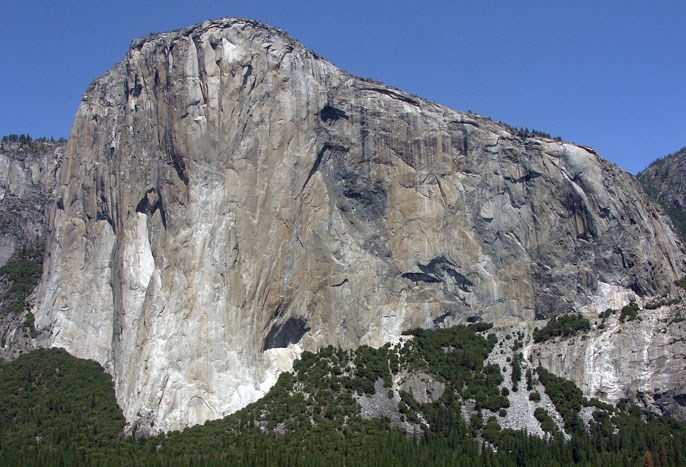
This week I decided to head out to Yosemite National Park to get a good look at some igneous rocks, particularly granite rocks. Granite is an intrusive igneous rock. This means that it is formed from magma deep underground. Granite actually contains many different types of minerals such as quartz, feldspar, hornbende, and biotite. The proportions of these minerals can even change the name of the granite. These particular set of minerals will make up something called Granodiorite, which is still granite, just has a different name to show its composition. Fascinating right!? If not, then at the very least they are pretty to look at.
-Matt
Week 8 - Tracey P - Pearl Harbor, Hawaii
This week, I pulled a Jules Verne and went to the distant future; the year is 7020. Mankind has moved off to far away planets, colonized other worlds, and left only a small group of people on Earth, those that wished to stay instead of venturing into the stars. My time machine landed me on the island of Oahu, in the Hawaiian Island chain, far off what used to be "California."
Surprisingly, the people here seem to have reverted to the more Pacific Islander lifestyle that existed before the US annexed and added the islands as a state.
I convinced the locals that I was friendly, and was just here to learn. They were distrustful of me, but were willing to share the history as they knew it. Apparently, climate change was a bigger issue than anyone could have anticipated. Governments attempted to take more and more drastic action but citizens continued to push-back until it was too late. Multiple companies poured their research dollars into space exploration instead of combating the looming crisis. Once the technology became viable, countries spent money on sending dozens of exploration vessels out. Like the doves from Noah's Ark, they returned with nothing, or were never heard from again, until a single transmission was received; success!
First, thousands of people, with the money and desire to leave, bought private spacecraft and escaped their dying home. Later, as the ability to traverse the stars became more affordable, more and more people set off into the vastness of space, hoping to find their place in the cosmos. Those that chose to stay were left to fend for themselves on a planet supposedly in its death-throes.
But there was still hope! With so many people leaving and so much industry shut down, the planet finally began to heal. These islanders chose a simpler life, free of most technology. I took a day to survey the island I had landed on, finding a vastly different coastline than I had remembered from my past. While Pearl Harbor itself remained about the same, the spur of land where Hickam AFB once stood had been reclaimed by the sea. Also now underwater was much of Waikiki, downtown Honolulu, and the entire airport grounds.
All of Kailua was underwater as well. Waipahu was turned into an island in the harbor, much like Ford Island. The north shore destinations of Haleiwa and Waialua were also swallowed into the Pacific.
I thanked my hosts and headed back to my time machine, ready to return to my own time. If this future is the one set to come true, I'm only glad that I will not live to see such interesting times. As I punch i the digits for the date after I departed (to avoid any overlapping paradoxes and such), and just after I began the jump sequence, I noticed something amiss. My display was acting up again, and something was wrong with the date and time stamps of my destination! I would NOT be returning to 2020! Where will this blasted machine take me to this time?!
Surprisingly, the people here seem to have reverted to the more Pacific Islander lifestyle that existed before the US annexed and added the islands as a state.
I convinced the locals that I was friendly, and was just here to learn. They were distrustful of me, but were willing to share the history as they knew it. Apparently, climate change was a bigger issue than anyone could have anticipated. Governments attempted to take more and more drastic action but citizens continued to push-back until it was too late. Multiple companies poured their research dollars into space exploration instead of combating the looming crisis. Once the technology became viable, countries spent money on sending dozens of exploration vessels out. Like the doves from Noah's Ark, they returned with nothing, or were never heard from again, until a single transmission was received; success!
First, thousands of people, with the money and desire to leave, bought private spacecraft and escaped their dying home. Later, as the ability to traverse the stars became more affordable, more and more people set off into the vastness of space, hoping to find their place in the cosmos. Those that chose to stay were left to fend for themselves on a planet supposedly in its death-throes.
But there was still hope! With so many people leaving and so much industry shut down, the planet finally began to heal. These islanders chose a simpler life, free of most technology. I took a day to survey the island I had landed on, finding a vastly different coastline than I had remembered from my past. While Pearl Harbor itself remained about the same, the spur of land where Hickam AFB once stood had been reclaimed by the sea. Also now underwater was much of Waikiki, downtown Honolulu, and the entire airport grounds.
 |
| Map courtesy of NOAA |
All of Kailua was underwater as well. Waipahu was turned into an island in the harbor, much like Ford Island. The north shore destinations of Haleiwa and Waialua were also swallowed into the Pacific.
I thanked my hosts and headed back to my time machine, ready to return to my own time. If this future is the one set to come true, I'm only glad that I will not live to see such interesting times. As I punch i the digits for the date after I departed (to avoid any overlapping paradoxes and such), and just after I began the jump sequence, I noticed something amiss. My display was acting up again, and something was wrong with the date and time stamps of my destination! I would NOT be returning to 2020! Where will this blasted machine take me to this time?!
Week 8 - Global Warming - Ryan Klassy
 |
| Boston after sea level rise due to global warming and melting of ice caps. Retrieved from: https://coast.noaa.gov/slr/ (screenshot taken of map) |
Today I decided to brush the dust off the old TARDIS and zip a few thousand years into the future. I was a little rusty with the controls, but I think I landed somewhere around the year 7020, plus or minus a decade. My location was set for the New England Aquarium in Boston, MA, but I think I might have done something wrong, because when I opened the door I saw nothing but water! I mean, I was expecting to see water at an aquarium, but not like this. I was staring out into the open sea. Then it hit me; the aquarium was gone. To be more specific, what was left of the aquarium was now deep under water. Not only that, but it sure did feel hot outside for Boston this time of year! It was mid March and it was 75 degrees outside! This was about 20 degrees hotter than I was expecting. I checked the atmospheric readings on my panels and sure enough, the temperature had risen due to the high concentrations of greenhouse gasses. CO2 was at over 900 ppm! That is enough to give me a headache for sure.
So I decide to fly in a bit to the west where I can see the new coast line. Obviously there has been some serious sea level rising, but what could have caused this? I go to the new beach and am happy to see that the city has rebuilt and is thriving. Of course the technology is quite a bit more advanced and this place is far busier than I have ever seen it. The flying cars look like something out of a movie; all moving autonomously through the air, perfectly spaced, all moving at the exact same speed to their destinations. So I land on the beach where I see a person on the harbor eating a sandwich. I sit next to him and ask him if I can ask him a few questions about the past. Lucky me, he is happy to talk!
He tells me to look out over the water, so I do. All I see is the great Atlantic Ocean. He then tells me that part of Boston used to be right there! Sky scrapers and all. Over hundreds and hundreds of years, CO2 emissions from the burning of fossil fuels increased so much that the greenhouse effect overcame the planet. Scientists were trying to warn the public about the dangers of these gases, but they just didn't listen. Everyone continued driving their cars. He explained to me that as the shortwave gamma radiation from the sun enters the Earth's atmosphere, it reflects off the ground and becomes longwave infrared radiation. This radiation is easily absorbed by the excess greenhouse gasses and in turn, heats up the atmosphere. Although CO2 emissions from burning fossil fuels was the biggest contributor to this, it was not alone. Methane gasses from farming and livestock grew and incredible rates, eventually surpassing the emissions for CO2 (only due to the advancements of renewable energy lowering our dependence on fossil fuels). Methane from livestock, combined with Nitrous Oxide from excess soil fertilization kept the temperature rising.
Wow, I couldn't believe that human beings were capable of changing the environment that much! Just when I was thinking that, he said that not all the reasons for the increase were due to human activity. He said that in the year 3001, Yellowstone in Wyoming had erupted, spewing massive amounts of ash across most of the United States. The amount of greenhouse gasses sent out from that eruption accounted for almost an entire year of human caused burning of fossil fuels. All in all, volcanism, both on land and underwater in deep sea trenches, only accounted for about 1% of the overall problem.
I asked him why the scientists and governments didn't do anything to stop this. He told me that they did. They tried many different things. They first tried putting large reflectors on the ocean to reflect more light back into space, but unfortunately these reflectors were negatively effecting the marine life in the ocean. Lowering the amount of marine life could send the entire ecosystem into chaos, so they were forced to remove them. Next they tried injecting aerosols into the atmosphere, to reflect more radiation, but this began to change weather systems all around the globe and natural forests and areas of vegetation began to suffer. In the year 6001, they finally had the technology to launch giant mirrors into space to help reflect the sunlight. This was the best solution that they could have done, and they continued to do this for over 100 years. He then said he wanted to show me something. He reached into his bag and pulled out a flimsy little pair of paper sunglasses. I recognized them as being similar to the solar eclipse glasses I have back home. He told me to put them on and look up at the sun. When I did, I instantly noticed a tiny black dot, almost perfectly centered in the sun. He told me that those were the mirrors that saved Boston from being completely covered under water.
Since those mirrors were installed, the rise in global temperatures began to stabilize. He told me that about 6% of the sun's radiation was reflected back by those mirrors. Millions of them. Large sheets of solar mirrors orbiting the earth. The drastic number of 6% was not how it started, but they had to increase the number of mirrors until they found the sweet spot.
Although it was sad to see how far this had to go before humanity fixed the problem, I was happy to see that they were making progress. Although I didn't get to go to the aquarium, I was pleased to see that 100% of fossil fuel burning had been banned worldwide, and that the main source of energy for humanity was now solar. So I popped on my shades, hopped in the TARDIS and went back home to share the news.
Week 6 - Matt Bulow - Clear Lake Reservoir

This week I went to California to check out Clear Lake Reservoir. What fascinates me about this place is that this body of water is surrounded by volcanic rock! In fact, most of north eastern California is made up of volcanic rock. Majority of the area around Clear Lake is made up of Quaternary volcanic flow rocks from the Quaternary age. There is also some minor pyroclastic deposits as well. On the western side of Clear lake there is Quaternary pyroclastic and volcanic mudflow deposits from the Quaternary age too. It isn't until you head west a little ways until you get around Tule Lake that you can see some marine and nonmarine sedimentary rocks. These sedimentary rocks are from the Pleistoene-Holocene age. Its funny how two areas so close together can not only look different, but be made up of entirely different things as well! Anyways, I'm gonna go try and catch me some fish now. Might go for a swim too if the fishing fails.
-Matt
Subscribe to:
Posts (Atom)